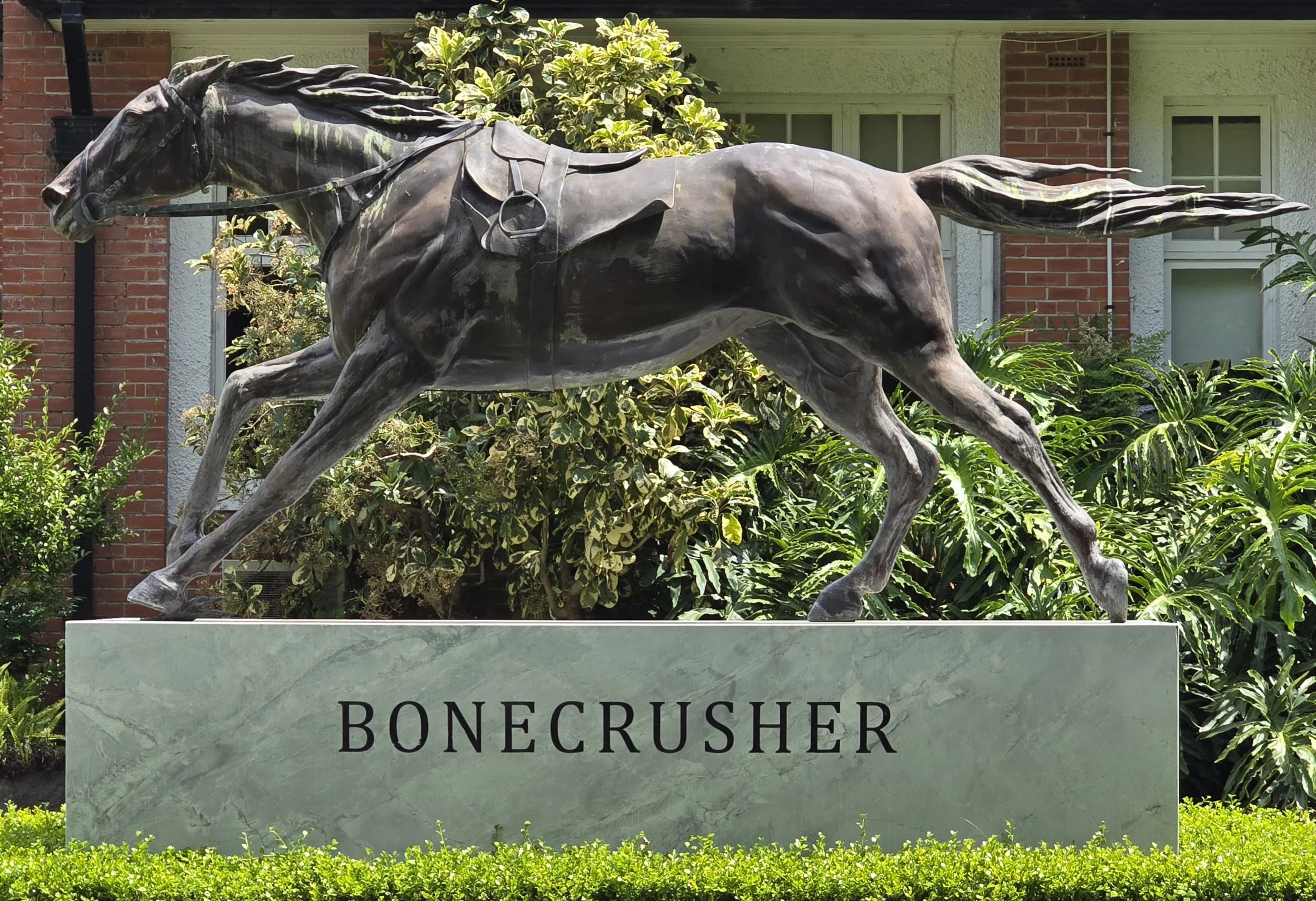
BONECRUSHER

…”and bonecrusher races into equine immortality”
Owen Larsen, who for many years during the 1960s and 1970s was a small-time breeder on a property at Newstead, Hamilton. He searching for a stallion bred for speed, when he first saw PAG-ASA (by Kaerou Star) by French champion, TANTIEMEIN in Sydney and he was fairly impressed. In the mid Seventies, Owen decided that the NZ Broodmares needed to produce some faster horses, that we were putting too much staying blood into our racehorses, so he decided to try to find a stallion bred for speed, like a STAR KINGDOM line horse. Soon after viewing the pedigree and race performance sheet, Owen was convinced with what he saw and purchased the horse, shipping him straight to Dave O’Sullivan’s Matamata stables where he went into full work.
After a few unsatisfactory performances in New Zealand, a medical examination including a cardiograph revealed that PAG-ASA not in the ideal physical condition to continue racing. Consequently, he was retired to stud, where he was eventually bred by Bill Punch with the broodmare, IMITATION (Oakville), who turned out to be the dam of the future champion horse BONECRUSHER.
It was an unusual turn of events that led to the acquisition of the seemingly unfashionable Pag-Asa colt by owner Peter Mitchell in 1982, made after consulting with a self-styled breeding expert during the annual yearling sale. Mitchell had a background in racing and gambling, in that his father had once been a capable owner-trainer based in Ellerslie who had enjoyed high-level success with MISERE. The nondescript brown gelding of ordinary breeding, MIisere won both the 1965 ARC Newmarket and Royal Stakes, as well as the Telegraph Handicap the following year.
An old joker named Harold Hampton who was a postmaster used to go around the sales with his odd theories on how you could find a good future racehorse. Harold recognised the distinguished ancestors in Bonecrusher’s pedigree include Hyperion, Bahram, Nearco, Dastur, Pharos, Blenheim, Phalaris and The Tetrarch. A rollcall of the good and great, his pedigree had no value to most onlookers, but Peter purchased the first one that year and called him SUPERBRAT. He ran a couple of times and didn’t do much. Mitchell stuck with the bloodlines, and next time to the sales he bought BONECRUSHER and sent him to trainer Frank Ritchie, who was just starting on his own and battling away with his strapper son, 16 year old Shaun Ritchie in tow. He had training in the shadow of his old man, the astute Merv Ritchie, who had handled some fine racing thoroughbreds over the years, including YAHABEEBE, BLYTON and TERRIFIC.
Mitchell purchased Bonecrusher for a handy $3250 from the Claudelands Yearling Sale in Waikato. In the weeks after the sale when Mitchell was casting about for a name, the American heavyweight boxing champion, James ‘Bonecrusher’ Smith, administered Frank Bruno’s first professional defeat at Wembley Arena in London. Smith’s nickname appealed to Mitchell and seemed rather appropriate for his latest yearling, given the scar he bore from his earlier fight with the fence.
In temperament, Bonecrusher was a nervous horse and not much time was wasted in gelding him, particularly given Mitchell’s and Ritchie’s previous experience with his highly-strung, year-older brother.
He first hit the track in August of 1984 where he won three of his first five starts as a juvenile, including one in Gr.3 Ecilpse Stakes (on protest) at Ellerslie before embarking on an ill-fated three start campaign in Australia with jockey Gary Stewart. Unable to qualify for the prestigious Golden Slipper, Bonecrusher was returned home after those three lacklustre runs. Bonecrusher commenced his three-year-old campaign with four consecutive placings including finishing third behind RANDOM CHANCE and FIELD DANCER in the 1985 Gr.1 New Zealand 2000 Guineas (1600m) at Riccarton.
BONECRUSHER then won his next seven starts straight, including the Gr.1 Bayer Classic (1600m), Avondale Guineas (2000m) and the Gr.1 New Zealand Derby (2400m) before defeating the older horses in the New Gr.1 Zealand Stakes (2000m) at Ellerslie. Ritchie was convinced that trip away to Christchurch was the making of the horse. He had hurt himself in an incident on the truck before he went to Christchurch and missed a lot of work. Bonecrusher went into the 2000 Guineas underdone and the the trainer believed the race would either flatten him or bring him on, and thankfully it was the latter.
The rangy gelding had grown since his failure in three juvenile racesthe previous autumn. He now stood fully 16.1 hands, high at the wither and with his long barrel and rein, looked every inch a stayer. Bonecrusher’s most notable physical characteristic, apart from his rich copper coat, was just how deep and flat he was in the shoulders. Although initially off his food upon landing back in Australia, Bonecrusher soon regained his appetite. He and his regular jockey, Gary Stewart were here for two races only, the first at Rosehill four days after arriving.
Then he went to Sydney and won the Gr.1 Tancred Stakes (2400m) with a monumental finish to come from last on the home turn in the sixteen-horse field to win going away. Bonecrusher unleashed a tremendous burst of speed in the straight to defeat fellow three-year-old RANT and RAVE by three-quarters of a length, with fellow Kiwi, ABIT LEICA, a further one-and-a-quarter lengths away. Bonecrusher was even eased up by Stewart before hitting the line.
After his barnstorming finish to win the Tancred Stakes at Rosehill, Bonecrusher was sent to the post for the Gr.1 Australian Derby at 6/4 on favourite. But it was a tough and tumble race. Going out of the straight the first time the crowding field forced Bonecrusher to crash into the running rail, as the tell-tale stains of whitewash on his off-hind quarters confirmed afterwards. Coming towards the home turn Bonecrusher had moved into seventh position. The favourite assumed the lead just inside the 200 metres post and proceeded to outstay his rivals with true grit although the result seemed never really certain until within the shadows of the winning post.
Gary Stewart, the 23-year-old Derby winning jockey, was an Auckland city kid brought up in Avondale and had ridden roughly a hundred winners over five seasons. Stewart had served his apprenticeship at Takanini under trainer Brian Deacon, who was also the master of both Maurice Campbell and Greg Childs. In 1982, a severe head injury suffered during a training accident had seen Stewart condemned to a two-year absence from the saddle. When he first tried to come back he suffered blackouts and stewards had hesitated before reinstating his licence. Bonecrusher came into Stewart’s life at precisely the right time.
In the weeks immediately following Bonecrusher’s Sydney autumn campaign and his return to Ellerslie, there were rumours that the gelding would be sold for $NZ1.5 million and do his future racing in America and Europe, but thankfully nothing came of it.
In the spring of 1986, Bonecrusher achieved his greatest triumph and scaled the greatest heights by winning the Gr.1 W.S Cox Plate over the Dave and Paul O'Sullivan-trained (OUR) WAVERLEY STAR, a race that has been hailed as, 'the race of the century.' The publicity in the press and on television surrounding the imminent clash between these two New Zealand champion racehorses was unprecedented. Never in the history of the W. S. Cox Plate had the market been so dominated by two Kiwi-trained gallopers to be ridden by two Kiwi-based jockeys. Neither Gary Stewart nor Lance O’Sullivan had ever ridden the Moonee Valley course before W. S. Cox Plate Day, but each had walked it a few times the previous week.
Both horses had drawn poorly at the barriers, with Bonecrusher in gate 10 and Waverley Star as near as gate 12. The two great horses went to war from the 600m mark with Bonecrusher prevailing in a colossal head-to-head dual as the renowned racecaller Bill Collins delivered one of the most memorable and dramatic calls in racing history...
“and Bonecrusher races into equine immortality"
Although he lacked the brilliance of Black Caviar or the dominance of Winx, his courage endeared him to many. Even when it appeared he could not win, he prevailed. In the Cox Plate, Our Waverley Star settled wide, in mid-field, while the chestnut, Bonecrusher was towards the back of the field. At the 800 metres mark, Bonecrusher (ridden by Gary Stewart) powered out swiftly around the field to be immediately shadowed by the slick Our Waverley Star (ridden by Lance O'Sullivan). Quickly, the two horses cleared out from the rest of the field. Race caller Bill Collins questioned the two horses breakneck tactics,
Here come the New Zealander’s...have they gone too early?"
OUR WAVERLEY STAR built up a length lead, which was soon countered by Bonecrusher. As they entered wide into the short home straight at the Moonee Valley, Bonecrusher had a slender lead. In an instant Our Waverley Star gathered him in again and it seemed he would pull away. But Big Red fought back hard down the straight to gather in his nemesis stride by stride, winning by a neck at the post. And then for one brief moment a hush settled over Moonee Valley. Not only were both horses and both jockeys exhausted when they hit that line, but so was the crowd and an emotional Bill Collins, his voice breaking as he uttered that last memorable phrase. The huge crowd erupted and it is still considered one of the single greatest thoroughbred races ever witnessed down under, and rightly so. THE FILBERT would finish 3rd, with two further NZ breds, DANDY ANDY and DROUGHT finishing 4th and 5th respectively.
Beyond measure, the sixty-fifth running of the W. S. Cox Plate had lived up to all expectations. The twenty-four thousand strong crowd accorded the two gladiators one of the most sustained ovations ever heard at the Valley as these absolute thoroughbreds returned to scale. Bart Cummings observed: “That is the greatest race I have ever seen.” Mitchell then shouted dozens of family and friends, and funnily enough even local reporters to dinner out at Melbourne's finest Chinese restaurant, the Flower Drum as the victorious team celebrated long into the night. Neither Bonecrusher nor Waverley Star was ever to be quite the same racehorse again following that October afternoon. It has possibly taken more out of the pair then anyone could have imagined.
A tilt at the Japan Cup in 1986 almost ended in tragedy as the horse contracted a mystery virus in Tokyo, thankfully aided in recovery by the JRA vets. Within seventy-two hours of the big race, the chestnut gelding was found in his stall shivering and in pain, having contracted a severe viral infection. Clearly, the Japan Cup dream was over. Both trainer Frank Ritchie and jockey Gary Stewart firmly believe that Bonecrusher would have emerged victorious in the Cup, considering his exceptional performance during track work.
The Australian Cup was the race, not the Cox Plate, which trainer Frank Ritchie said undid Bonecrusher in 1987. Rider Gary Stewart described it as the roughest race he'd ridden in, and Big Red came back to scale with a chunk out of his leg after running 2nd in a torid battle with AT TALAQ. Stewart observed that there was "plenty spent to beat him", a claim interpreted by the Aussie press to mean payoffs to riders by bookies, two of whom were reported to be on the breadline after massive payouts on the result.
Bonecrusher continued to campaign at five, six, and seven years of age. He won three races in New Zealand, including a second Air New Zealand Stakes in 1988, but was unable to reach his previous heights in Australia.
All up, Bonecrusher raced 44 times for 18 wins, 5 second places, and 12 third places. His races ranged from 880m to 2400m. He won 9 Group One races, 3 Group 2 races, and 2 Group 3 races, and earned prize money of NZ$674,225 and AU$1,679,495. He was retired after finishing 3rd in the Gr.3 Starway Stakes in December 1989 at the age of seven, considered one of New Zealand's greatest ever gallopers.
After retirement Bonecrusher was cared for by his owner, Peter Mitchell, on a property in Takanini. In retirement, he was a guest of the Moonee Valley Racing Club. His last public appearance was Derby Day in 2003. In 2010, he was inducted into the New Zealand Racing Hall of Fame. He became New Zealand’s first million-dollar-earning galloper and retired having amassed nearly $3 million. He made several public appearances in retirement before his passing in 2015. BONECRUSHER is buried next to the Ellerslie parade ring where his statue attracts numerous visitors who are all eager to pay tribute to the mighty, BIG RED. The statue’s head looks towards horses as they enter the Parade Ring, wishing them all good luck for their upcoming race.
RACE RECORD - 44: 18-5-12
EARNINGS - NZ$674,225 & A$1,679,495
Bayer Classic (1985)
New Zealand Derby (1985)
Air New Zealand Stakes (1986 & 1988)
Tancred Stakes (1986)
Australian Derby (1986)
Caulfield Stakes (1986)
W. S. Cox Plate (1986)
Underwood Stakes (1986)
Australian Cup (1987)
The famous line by race caller Bill Collins will always be synonymise with a great racehorse in a clash hailed as, 'THE RACE OF THE CENTURY'